
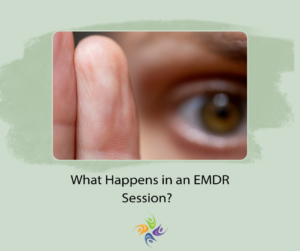
 Many people think all that happens in therapy is talk, talk, talk. However, therapists have a lot of tricks and tools up their sleeve, and EMDR is one of them.
In fact, Eye Movement Desensitization and Reprocessing therapy (EMDR) has proven so effective, it has become one of the leading trauma treatments.
What is EMDR?
 Emerging in the late 80s, EMDR was the brainchild of American psychologist Francine Shapiro. In a nutshell, Shapiro noticed that certain eye movements reduced the intensity of traumatic memories. Since then, there have been decades of more research. Today, EMDR is touted as one of the most effective ways of helping people process emotionally charged trauma.
But what actually happens in an EMDR session and how does EMDR work? Here’s everything you need to know.
What Actually Happens in an EMDR Session?
 It’s important to note at the onset that you are in control during the whole EMDR process. If the experience becomes too overwhelming, you are free to let your therapist know.
The EMDR process can be broken down into 4 steps:
- Preparation
Prior to beginning EMDR treatment, your therapist will help you identify the specific traumatic memories and events you want to target.
- Eye Movement (Bilateral Stimulation)
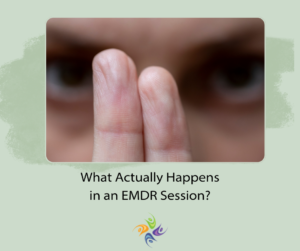
Step two involves thinking about the specific upsetting memory, and focusing on the aspect of it that haunts you the most. It’s important to sink into the emotion. It could be a feeling of helplessness, or a feeling of being trapped and terrified. As you sink into the emotional experience, your eyes are focused and following your therapist’s finger or wand. Some therapists use sound as a cue, like a ‘beep’ or ‘tap.’ Your eyes will focus on the implement as it moves back and forth, from left to right.
This is done in sets which last no more than a few minutes each.
- Processing
Once you’ve completed a few sets, you’ll process the experience with your therapist.
- Repeat
You’ll repeat the experience, however this time you’ll insert a more positive belief as you relive the memory. This can be something like, “I am strong,” or “I am safe, worthy, and I can handle this.”
What Makes EMDR So Effective?
 Researchers believe that one of the key aspects that makes EMDR so effective lies in the bilateral eye movements. The eye movements mimic REM sleep, which is crucial for emotional processing.
By utilizing this approach to target and process highly charged memories, repeating as necessary, the memories gradually shift from a present disruptive memory into a past event. Essentially, EMDR helps your brain resolve the painful experience. You’re no longer stuck in the past, the memory of the experience no longer has the power to bring you to your knees.
How Do I Find an EMDR Therapist?
 Many clinicians who treat trauma are well versed in EMDR. You can scan their website, or ask before you schedule an intake if this is something they provide.
At the Relationship Therapy Center, EMDR is a tool we often use to help our trauma patients. If your mind is often hijacked by a traumatic memory that plays out over and over again, EMDR can help. As always, please reach out to us any time with questions or details about how we can help.
Begin Trauma Therapy in the Sacramento Area or Online:
 Are you ready to find peace and healing after trauma? We are here to support you and provide high-quality evidence-based trauma treatment to people in the Sacramento Area and online for people living in the state of California. To begin trauma therapy in Fair Oaks, CA or Roseville, CA, please follow these steps:
- Reach out to our relationship therapy clinic for a free 15-minute phone consultation to learn more about trauma therapy.
- Meet with one of our compassionate trauma therapists.
- Begin trauma treatment and regain control in your life.
Other Services Offered at The Relationship Therapy Center in California:
In addition to trauma therapy, Our Sacramento area counseling clinics located in Roseville and Fair Oaks, CA are pleased to offer a variety of mental health services. Our couples services include: Counseling after infidelity, sex therapy, co-parent counseling, family therapy, divorce counseling, intensive couples retreats, and premarital counseling. Individual therapy services include, therapy for children, teen therapy, depression treatment, and individual relationship counseling. Our therapists offer online counseling in California to treat a variety of mental health concerns. Please reach out to our Sacramento area therapy office to learn more about the many ways we can help you or your loved ones heal and grow.

Certified Gottman Therapist
Nancy Ryan, LMFT & Certified Gottman Therapist, is the Founder and Clinical Director of Relationship Therapy Center, with 15+ years of experience supporting clients in Sacramento, Placer, and El Dorado Counties, and with offices in Roseville, CA, and Fair Oaks, CA. Our team also supports clients throughout California, Idaho, and Washington
She specializes in couples counseling, mentoring, and training her therapists on how to be excellent therapists. Nancy is also featured in a variety of media and provides couples therapy weekend workshops and retreats.
Relationship Therapy Center uses evidence-based approaches such as EMDR for trauma, Cognitive Behavioral Therapy (CBT), Acceptance and Commitment Therapy (ACT), Dialectical Behavior Therapy (DBT), Mindfulness, and Motivational Interviewing to treat individuals. Family therapy focuses on family systems and Play Therapy for children. Evidence-based couples therapy includes using the Gottman Method, Gottman Method Affair recovery/infidelity counseling, Emotionally Focused Therapy (EFT), Attachment therapy, and David Schnarch's Crucible Therapy, including differentiation. The whole team is in weekly training on trauma-informed care, somatic techniques, sex therapy, and different topics each year.
- Therapist for Childhood Emotional Neglect - October 8, 2026
- How do I Know if I Have Postpartum Depression? - October 1, 2026
- Is It a Midlife Crisis? - September 24, 2026