
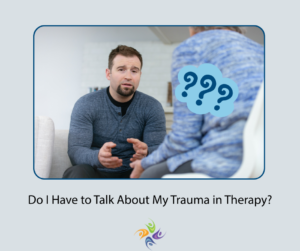
 If you have ever tried to explain something painful and felt your mind go blank, your body go numb, or your words disappear halfway through a sentence, that is not a sign that you are doing therapy wrong. Trauma is often hard to talk about for reasons that make complete sense. It affects the nervous system, memory, and sense of safety. The encouraging news is that healing does not depend on being able to tell the whole story in a neat, detailed way. At The Relationship Therapy Center, we offer trauma therapy in Roseville, Fair Oaks, and throughout the Sacramento area using approaches designed for exactly the places where language runs out.
Why Do I Shut Down When Talking About My Trauma?.
When people ask, why do I shut down when talking about trauma, the answer is usually not about motivation. It is about protection.
When something overwhelming happens, the body and brain do not always store it like an ordinary memory. Approaching that material later can feel threatening, even when you are sitting in a safe office with a kind therapist. That is why a person can want help very much and still go foggy, flat, silent, or disconnected the moment the conversation gets close.
Sometimes there is also an internal tug-of-war. One part of you may want relief. Another part may step in and say, not yet. From an IFS-informed perspective, that resistance is often a protector doing its job. It learned somewhere along the way that going near this material felt dangerous. A skilled trauma therapist does not bulldoze that part. They listen to it, respect it, and work with it.
That shift matters. When shutdown is understood as information instead of failure, therapy becomes a different experience. The response itself becomes the place to begin.
Do I Have to Talk About What Happened in Detail for Therapy to Work?
This is one of the biggest misconceptions keeping people from getting help.
Many adults assume trauma therapy means sitting down and retelling the worst moments of their lives in graphic detail. For many people, that picture alone is enough to make them avoid therapy altogether. Thankfully, that is not how the best trauma treatment usually works.
Approaches like EMDR and other body-based methods can work with a specific target instead of a complete narrative. A therapist may need enough information to understand what area of pain you are working on, but they do not need a full verbal documentary.
Brainspotting can require even less language. That is one reason it can be so helpful for people who feel stuck because they cannot find the words. If that question is part of your story, you may want to read Is Brainspotting Effective for PTSD? to understand why some trauma methods do not depend on detailed talking.
What matters most is not polished storytelling. What matters is being as forthcoming as you can about what is happening now. What do you notice in your body? What feels scary? What feels blank? What came up after your last session? That kind of present-moment honesty helps the therapist follow the work where it actually needs to go.
What If My Memories Don’t Make Sense, or I’m Not Sure What I’m Even Carrying?
Many people affected by trauma do not have a clean timeline or a fully coherent memory of what shaped them. Trauma can be fragmented, sensory, vague, or hard to place. That does not mean nothing happened. It means the experience was stored differently.
This is one of the quieter reasons people feel stuck before therapy even begins.
Some people know exactly what happened. Others know the feeling of it more than the facts of it. They may say, “I know the movie, but not which scene is next.” That is actually a useful way to understand trauma work. You may sense the overall impact without knowing exactly which memory, moment, or layer will come forward first.
Trauma does not always arrive in chronological order. It may show up as body tension, a repeated reaction in relationships, a flash of emotion, or a sense that something is there but not fully available. That does not make your experience less real. It simply means your system stored it in a way that isn’t organized like ordinary narrative memory.
Part of trauma therapy is building tolerance for some uncertainty. You may not know at the beginning exactly what you are carrying, what will surface first, or how all the pieces fit together. The therapist’s job is not to require you to arrive with the whole picture already sorted. The therapist’s job is to follow what emerges, safely and skillfully.
If you want a broader picture of how this works in practice, this is a good place to link to What Actually Happens in Trauma Therapy?.
How Do I Cope If I Start Seeing My Past More Clearly and Can’t “Unknow” It?
This fear deserves respect. Trauma therapy can bring new clarity, and clarity sometimes changes how you understand your life. But seeing more clearly is not the same as becoming more broken. Often, it is the beginning of things finally making sense in a way they never did before.
A lot of people hesitate before trauma therapy because they worry about what insight will cost them.
What if the work opens a door you cannot close? What if you begin to understand your childhood, your relationships, or your coping patterns in a way that changes everything? Those are real fears, not overreactions.
The truth is that new understanding can come with grief. You may begin to see what you needed and did not receive. You may recognize how long you have adapted to pain that was never named. You may feel sadness about what might have been different if you had known sooner. That grief can feel heavy, but it is often a healthy sign. It means the insight is no longer just intellectual. It has landed.
This is also why being forthcoming matters so much, even when it feels awkward or vulnerable. If something surfaces between sessions, if you feel more tender than expected, if an insight hits harder than you thought it would, bring it back into the room. The therapist cannot help pace and hold the work if they do not know what the work is stirring.
What Is the Hidden Grief in Trauma Recovery?
People often expect trauma therapy to bring memories, tears, or hard sessions. What they are less prepared for is grief.
Not just grief about what happened, but grief about what it cost. The years spent coping in ways that made sense but came at a price. The relationships shaped by fear or self-protection. The younger version of you who had to survive without the support, language, or safety you needed.
This kind of sadness can be disorienting because it may arrive after progress has already started. Some people worry that it means therapy is making them worse. Usually, it means something much more hopeful: the work is reaching a deeper truth.
You cannot grieve clearly until you can see clearly. That is why this grief is often part of real healing. It is not a detour. It is part of the path.
And yes, sometimes that means crying more than you expected. That is allowed. A good trauma therapist does not panic when emotion comes forward. They help make room for it without letting it overwhelm the process.
Why Does Trauma Therapy Feel So Exhausting?
Trauma therapy can be deeply tiring because the nervous system is doing real work, even when the session looks quiet from the outside. A person may say very little and still leave drained because their body and brain have been actively engaging material long held in protection.
This kind of exhaustion surprises many people.
You may leave a session thinking, “I barely even talked,” and still feel completely wiped out. That happens because trauma work is not only conversational. It is neurological, emotional, and physical. Even when a session seems calm, your system may be working hard beneath the surface.
The work also continues after the appointment ends. Dreams may get more vivid. Feelings may sit closer to the surface. Old memories may pop up unexpectedly. That does not always mean something is wrong. Often, it means your system is still integrating what began in the session.
This is why pacing matters so much. Going faster is not always better. Supporting yourself between sessions matters too—sleep, rest, quiet, hydration, and enough margin in your day to recover. Those are not extras. They are part of treatment.
Begin Trauma Therapy in the Sacramento Area
Not having the words does not disqualify you from healing. Neither does shutting down, feeling unsure, or being afraid of what might surface. These are deeply human trauma responses, and they are exactly the kinds of experiences that trauma-focused therapy is designed to meet with care.
At The Relationship Therapy Center, we work with adults in Roseville, Fair Oaks, and throughout the Sacramento area who know something hurts but may not know how to explain it yet. You do not need a perfect story. You do not need the right starting sentence. And you do not need to push past your own protection to prove you are ready.
If you want a fuller look at treatment options, read What Is the Most Effective Treatment for Trauma?.
And if you are ready to take the next step, learn more about our trauma therapy services or reach out for a consultation.
FAQ
What if I’ve tried therapy before and couldn’t talk about it then either?
That is important information, not evidence that therapy cannot help. Trauma-focused approaches are designed specifically for people who cannot easily access or narrate what happened.
Is it normal to feel worse before I feel better?
Sometimes things feel more tender before they settle. That does not necessarily mean the therapy is going badly. It may mean important material is being approached and needs careful pacing.
What if I start talking and can’t stop, or lose control?
That fear is common. Good trauma therapy includes preparation and containment so that difficult material can be opened and closed safely. You are not expected to manage overwhelming emotions on your own.
Begin Trauma Therapy in the Sacramento Area or Online:
Are you ready to find peace and healing after trauma? We are here to support you and provide high-quality evidence-based trauma treatment to people in the Sacramento Area and online for people living in the state of California. To begin trauma therapy in Fair Oaks, CA or Roseville, CA, please follow these steps:
- Reach out to our relationship therapy clinic for a free 15-minute phone consultation to learn more about trauma therapy.
- Meet with one of our compassionate trauma therapists.
- Begin trauma treatment and regain control in your life.
Other Services Offered at The Relationship Therapy Center in California:
In addition to trauma therapy, Our Sacramento area counseling clinics located in Roseville and Fair Oaks, CA are pleased to offer a variety of mental health services. Our couples services include: Counseling after infidelity, sex therapy, co-parent counseling, family therapy, divorce counseling, intensive couples retreats, and premarital counseling. Individual therapy services include, therapy for children, teen therapy, depression treatment, and individual relationship counseling. Our therapists offer online counseling in California to treat a variety of mental health concerns. Please reach out to our Sacramento area therapy office to learn more about the many ways we can help you or your loved ones heal and grow.
Certified Gottman Therapist
Nancy Ryan, LMFT & Certified Gottman Therapist, is the Founder and Clinical Director of Relationship Therapy Center, with 15+ years of experience supporting clients in Sacramento, Placer, and El Dorado Counties, and with offices in Roseville, CA, and Fair Oaks, CA. Our team also supports clients throughout California, Idaho, and Washington
She specializes in couples counseling, mentoring, and training her therapists on how to be excellent therapists. Nancy is also featured in a variety of media and provides couples therapy weekend workshops and retreats.
Relationship Therapy Center uses evidence-based approaches such as EMDR for trauma, Cognitive Behavioral Therapy (CBT), Acceptance and Commitment Therapy (ACT), Dialectical Behavior Therapy (DBT), Mindfulness, and Motivational Interviewing to treat individuals. Family therapy focuses on family systems and Play Therapy for children. Evidence-based couples therapy includes using the Gottman Method, Gottman Method Affair recovery/infidelity counseling, Emotionally Focused Therapy (EFT), Attachment therapy, and David Schnarch's Crucible Therapy, including differentiation. The whole team is in weekly training on trauma-informed care, somatic techniques, sex therapy, and different topics each year.
- Therapist for Childhood Emotional Neglect - October 8, 2026
- How do I Know if I Have Postpartum Depression? - October 1, 2026
- Is It a Midlife Crisis? - September 24, 2026