
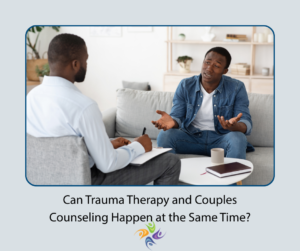
 Yes — for many people, trauma therapy, couples therapy, and marriage counseling can happen at the same time, and often that is not only possible but genuinely helpful. They are not doing the same job. Individual trauma work addresses what one or both partners are carrying internally. Couples work addresses what has formed between them over time. When both are needed, and the situation is stable enough to support them, doing them in parallel can create more movement than choosing only one. At The Relationship Therapy Center, we help individuals and couples across Roseville, Fair Oaks, and the greater Sacramento area figure out what combination makes the most sense.
Why Would Someone Need Both Trauma Therapy and Couples Counseling?
These two forms of therapy target different layers of the same struggle. Couples work focuses on the cycle between partners. Trauma work focuses on the stored survival responses inside one or both people. When both layers are active, addressing only one often leaves important progress on the table.
This question usually comes up when something isn’t shifting.
Maybe the couple understands their pattern, but the same conflict still blows up. Maybe one partner shuts down every time the conversation gets vulnerable. Maybe closeness feels possible for a moment, then suddenly unsafe. In those cases, it is often not enough to work only on communication.
Couples therapy helps with the relational side: trust, conflict, repair, recurring hurts, emotional disconnection, and the habits the relationship has built over time. But it cannot directly calm a nervous system that is reacting to an old threat. If someone floods quickly, disappears emotionally, or becomes impossible to reach in certain moments, the issue may be living below the level of relationship skills.
That is where individual trauma therapy matters. It works with the internal responses that keep hijacking the present: stored fear, body-level activation, shutdown, hypervigilance, or overwhelming emotional charge.
At the same time, individual healing does not automatically change the relationship structure waiting at home. The couple still has shared injuries, patterns of protection, and ways of relating that may need direct attention. This is why individual trauma therapy, while in couples counseling, can make so much sense. As one track reduces reactivity, the other helps the couple use that new space well.
Does Couples Therapy Sometimes Reveal the Need for Trauma Work?
Yes, often. Couples work regularly uncovers areas where the relationship cannot move forward until an individual issue is addressed. This is not a sign that the couple’s therapy has failed. It is often a sign that the work has gotten clear enough to identify what is actually blocking progress.
This is something we see frequently at RTC.
A couple comes in for relationship help. They are motivated. They are learning. They are using the tools. But the same wall keeps appearing. One person cannot stay present in certain conversations. Another cannot receive reassurance, no matter how sincere it is. A topic becomes emotionally radioactive every time it comes up.
When couples therapy is gaining traction, there is usually a felt sense of movement. The cycle loosens. People recover faster. Understanding deepens. When the work keeps resetting to the same stuck place, it often means the issue is not only relational.
Sometimes the couple’s work is what finally exposes an unresolved individual wound.
Something old is sitting underneath the current conflict, and no amount of careful communication can fully get around it. In that situation, adding trauma work is not abandoning the relationship focus. It is treating the part that the relationship therapy has been running into all along.
Affair recovery is a good example. Betrayal can leave one or both partners with intrusive thoughts, intense vigilance, body-level panic, or emotional volatility that does not settle just because the couple has talked it through. Sometimes, couples’ work is enough. Sometimes it becomes clear that one or both people need more direct help working with the nervous system’s response to what happened.
If you want the bigger picture on that intersection, When Trauma Is Hurting Your Relationship is the primary piece this post supports, and What Does PTSD Look Like in a Marriage? can also help clarify how trauma can shape a couple’s daily life.
Does Trauma Therapy Have to Come First?
Not necessarily. The better question is usually not sequence, but capacity. Some people benefit from starting both forms of therapy at the same time. Others need stabilization or more focused support first. Good treatment planning is based on clinical fit, not a blanket rule.
This is where people often get conflicting advice.
They hear, “Do one at a time.” Sometimes that guidance is wise. Sometimes it delays the help the relationship actually needs. The key issue is not whether there is a universal order. There is not.
The key issue is whether the person and the couple can realistically handle both processes simultaneously.
If someone is in acute crisis, highly destabilized, or barely functioning day-to-day, starting with individual support may be the better call. If the couple’s conflict is so severe that doing parallel work right away is emotionally unsafe, pacing may need to be more careful.
But many people are not in that situation. They are hurting, reactive, disconnected, and stuck — yet still stable enough to benefit from both tracks. Waiting until all individual trauma work is “finished” before starting couples therapy can leave the relationship accumulating more injury in the meantime. Waiting until the relationship is repaired before addressing trauma can keep the deeper driver untouched for too long.
So, should I do trauma therapy or couples therapy first? Sometimes one starts before the other. Sometimes both start together. The best answer comes from assessment, not from a rigid formula.
Why Does RTC’s Model Make This Especially Possible?
RTC is set up for this kind of coordinated care because the practice understands both trauma and relationships from the inside. That means people do not have to choose between a trauma-focused clinic that does not really do couples work and a couples practice that misses the trauma layer.
Most practices lean heavily in one direction.
Some are strong with trauma but do not really work with couples. Others are strong with relationship dynamics but are not equipped to address the body-based fallout of trauma in a focused way. RTC is different because the overlap is built into the model.
The practice was founded through couples’ work and expanded its trauma services because the need kept showing up inside that couples’ work.
Over time, the pattern became impossible to ignore: partners flooding, shutdown that would not budge, affair recovery that needed more than conversation, and couples who understood their cycle but could not shift it.
Because that pattern has been seen from both sides for years, the recommendation to add trauma therapy does not come from guesswork. It comes from experience.
It also means care can be coordinated without making people start over somewhere else. When a couple is already in treatment, and one person needs individual work, that need can be identified within a practice that already understands the relationship context. That continuity matters.
For readers who want a fuller view of what the individual side involves, What Actually Happens in Trauma Therapy? is a helpful companion article.
Frequently Asked Questions
These are the questions people usually ask when deciding whether parallel work will help or create more confusion. Most of the time, the answer depends less on a strict rule and more on whether the treatment is thoughtful, coordinated, and paced well.
What if I’m worried my individual trauma work will affect the couples therapy?
It probably will affect it, often in helpful ways. As old triggers lose intensity, couples’ sessions often become more productive. Letting your couple’s therapist know that individual work is happening can help them track changes without needing every detail.
Can we do couples therapy first and add trauma therapy later if needed?
Yes. That is a very valid path. Many people discover the need for trauma work only after the couples therapy reveals what keeps getting in the way.
Do both partners need individual trauma work?
Not always. Sometimes one person’s history is the main driver. Sometimes, both people are carrying unresolved material that affects the relationship. That becomes clearer with careful assessment.
You Can Work on Both at Once — You Do Not Have to Choose
If you have been wondering whether it is okay to pursue both kinds of therapy, the answer is often yes. The real question is not whether the two approaches interfere with each other, but whether your situation would benefit from support at both levels of the problem.
If you are currently in couples work and suspect individual trauma treatment may also be needed, or you are considering trauma therapy and wondering whether the relationship should be part of the plan too, you do not have to solve that alone.
At The Relationship Therapy Center, we help people think clearly about what is happening inside each person and what is happening between them.
For the broader framework, read When Trauma Is Hurting Your Relationship. That piece explains why trauma can become the hidden blocker in relationship progress and how treatment can be tailored to both layers.
You do not have to pick a door blindly.
You do not have to wait for things to get worse.
You do not have to keep guessing which kind of help is the “right” one.
Sometimes the best plan is not one or the other. Sometimes it is both.
Begin Trauma Therapy in the Sacramento Area or Online:
Are you ready to find peace and healing after trauma? We are here to support you and provide high-quality evidence-based trauma treatment to people in the Sacramento Area and online for people living in the state of California. To begin trauma therapy in Fair Oaks, CA or Roseville, CA, please follow these steps:
- Reach out to our relationship therapy clinic for a free 15-minute phone consultation to learn more about trauma therapy.
- Meet with one of our compassionate trauma therapists.
- Begin trauma treatment and regain control in your life.
Other Services Offered at The Relationship Therapy Center in California:
In addition to trauma therapy, Our Sacramento area counseling clinics located in Roseville and Fair Oaks, CA are pleased to offer a variety of mental health services. Our couples services include: Counseling after infidelity, sex therapy, co-parent counseling, family therapy, divorce counseling, intensive couples retreats, and premarital counseling. Individual therapy services include, therapy for children, teen therapy, depression treatment, and individual relationship counseling. Our therapists offer online counseling in California to treat a variety of mental health concerns. Please reach out to our Sacramento area therapy office to learn more about the many ways we can help you or your loved ones heal and grow.
Certified Gottman Therapist
Nancy Ryan, LMFT & Certified Gottman Therapist, is the Founder and Clinical Director of Relationship Therapy Center, with 15+ years of experience supporting clients in Sacramento, Placer, and El Dorado Counties, and with offices in Roseville, CA, and Fair Oaks, CA. Our team also supports clients throughout California, Idaho, and Washington
She specializes in couples counseling, mentoring, and training her therapists on how to be excellent therapists. Nancy is also featured in a variety of media and provides couples therapy weekend workshops and retreats.
Relationship Therapy Center uses evidence-based approaches such as EMDR for trauma, Cognitive Behavioral Therapy (CBT), Acceptance and Commitment Therapy (ACT), Dialectical Behavior Therapy (DBT), Mindfulness, and Motivational Interviewing to treat individuals. Family therapy focuses on family systems and Play Therapy for children. Evidence-based couples therapy includes using the Gottman Method, Gottman Method Affair recovery/infidelity counseling, Emotionally Focused Therapy (EFT), Attachment therapy, and David Schnarch's Crucible Therapy, including differentiation. The whole team is in weekly training on trauma-informed care, somatic techniques, sex therapy, and different topics each year.
- Therapist for Childhood Emotional Neglect - October 8, 2026
- How do I Know if I Have Postpartum Depression? - October 1, 2026
- Is It a Midlife Crisis? - September 24, 2026