
 If the idea of ‘emotional bonding’ brings up terrifying images of a treetop ropes course or falling backward into someone’s arms, don’t worry. That’s not what we have in mind.
This piece covers small, simple, everyday steps you can take to get closer to your family. You see, most families spend time together physically, but often, everyone’s in their own world.
Someone’s scrolling, someone else is reading a book, and someone’s got headphones clamped over their ears playing video games.
So, what are these emotional bonding exercises, and why should anyone do them? Let’s dive in.
Why is Emotional Bonding so Important?
 Before we get started, it’s important to be clear on why you’re doing this: why should families care about creating a stronger emotional bond?
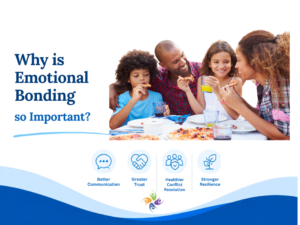
The answer is simple. Emotionally bonded families communicate better, trust one another more, are better at conflict resolution, and experience less conflict overall. They are also more resilient when hard times arise.
What are Some Emotional Bonding Exercises for Couples?
The thread that runs through every bonding exercise is shared experience. Every couple is different. That, coupled with where your emotional bond is currently, will play a part in how you choose to connect.
We’ll give you a few ideas here, but if none of them speak to you, remember: Discussing and planning an emotional bonding exercise is pretty much an emotional bonding exercise in and of itself.
 Here are 15 emotional bonding ideas for couples:
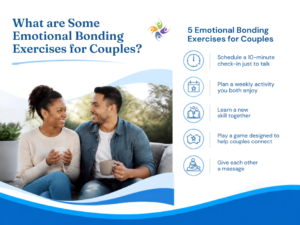
- Schedule a 10-minute check-in just to talk.
- Plan (and stick to) a weekly activity you both enjoy.
- Learn a new skill together.
- Play a game designed to help couples connect.
- Give each other a massage.
- Fine-tune your shared vision of the future.
- Address any elephants in the room (this may require help from a couples therapist).
- Share what you love about your partner, and have them do the same for you.
- Be vocal. Thank your partner for something they did that made you happy.
- Go deep. Emotional bonding happens when you discuss what is going on below the surface.
- Be intimate with one another.
- Focus on activities that allow you to connect, such as hiking, cooking, having a picnic while watching the sun set, or going on a road trip somewhere new…
- Ask your partner how you can better support them and vice versa.
- Have fun! Emotional bonding sounds heavy and involved, but it doesn’t need to be. Flirt, do something silly or unexpected, whatever makes you laugh.
- Build something together. This can be physical or metaphorical.
Your emotional bond will continue to grow through shared experiences and time spent together.
What are Some Emotional Bonding Exercises for the Whole Family?
 Family bonding follows the same concept. You want to cultivate an environment that is fun and stress-free, where everyone gets a chance to participate.
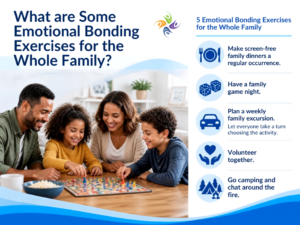
- Make screen-free family dinners a regular occurrence.
- Have a family game night.
- Have a weekly family excursion where everyone gets a turn choosing the activity.
- Volunteer together.
- Go camping and sit around the fire chatting over s’mores.
- Spend time creating something together, such as building a backyard garden.
- Go for a hike to a lake and pack sandwiches and swimsuits.
- Spend one-on-one time with each of your kids doing something special together.
- Make the evening dog walk a family event.
- Support one another’s pursuits; bring the family to cheer on a sibling sporting event.
- If your kids are younger, read them bedtime stories.
- Go to the zoo or a local park.
- Cook a meal together.
- Get together and do something nice for a friend or family member who is going through a hard time.
- Work on a yearly family memory book where everyone helps compile an album full of all the best memories from each year.
A healthy emotional bond is the foundation for feeling safe, loved, and accepted for who you are.
In a nutshell, a strong emotional connection equals a happy, healthy home life.
Begin Family Therapy in the Sacramento Area and Online in California
 Your family deserves to find peace and healing. Our family therapists can help. Ultimately, we want to strengthen the relationships you have with each other and restore love and harmony in your family. To begin counseling at our Roseville or Fair Oaks counseling center or online in the state of California please follow these simple steps:
- Contact our office to get more information about family counseling and to schedule a free consultation.
- Make an appointment with one of our caring therapists.
- Discuss your family’s unique needs and goals with your therapist.
- Develop a customized treatment plan tailored to your family.
- Engage in regular sessions to build stronger, healthier relationships.
- Find support and healing in your relationship!
Other Services Offered at The Relationship Therapy Center in California:
In addition to family therapy, Our Sacramento area counseling clinics located in Roseville and Fair Oaks, CA are pleased to offer a variety of mental health services. Our couples services include: Counseling after infidelity, sex therapy, co-parent counseling, family therapy, divorce counseling, intensive couples retreats, and premarital counseling. Our individual therapy services include, therapy for children, teen therapy, depression treatment, and individual relationship counseling. Our therapists offer online counseling in California to treat a variety of mental health concerns. Please reach out to our Sacramento area therapy office to learn more about the many ways we can help you or your loved ones heal and grow.

Certified Gottman Therapist
Nancy Ryan, LMFT & Certified Gottman Therapist, is the Founder and Clinical Director of Relationship Therapy Center, with 15+ years of experience supporting clients in Sacramento, Placer, and El Dorado Counties, and with offices in Roseville, CA, and Fair Oaks, CA. Our team also supports clients throughout California, Idaho, and Washington
She specializes in couples counseling, mentoring, and training her therapists on how to be excellent therapists. Nancy is also featured in a variety of media and provides couples therapy weekend workshops and retreats.
Relationship Therapy Center uses evidence-based approaches such as EMDR for trauma, Cognitive Behavioral Therapy (CBT), Acceptance and Commitment Therapy (ACT), Dialectical Behavior Therapy (DBT), Mindfulness, and Motivational Interviewing to treat individuals. Family therapy focuses on family systems and Play Therapy for children. Evidence-based couples therapy includes using the Gottman Method, Gottman Method Affair recovery/infidelity counseling, Emotionally Focused Therapy (EFT), Attachment therapy, and David Schnarch's Crucible Therapy, including differentiation. The whole team is in weekly training on trauma-informed care, somatic techniques, sex therapy, and different topics each year.
- Therapist for Childhood Emotional Neglect - October 8, 2026
- How do I Know if I Have Postpartum Depression? - October 1, 2026
- Is It a Midlife Crisis? - September 24, 2026