
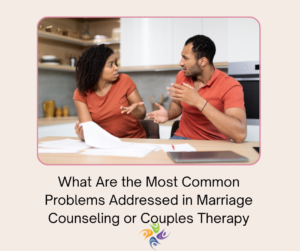
 If you’re wondering whether your relationship problems are “bad enough” for therapy—or if other couples even deal with the same things—you’re not alone. At The Relationship Therapy Center, we’ve worked with hundreds of couples across Roseville, Fair Oaks, and the greater Sacramento area. And while every relationship is unique, the patterns that bring couples through our doors are remarkably consistent.
Here’s what we’ve learned: couples often think they’re fighting about the surface issue—money, chores, parenting, sex. But the real problem is usually the relationship dynamic underneath. Patterns that erode safety, friendship, trust, and connection over time. That’s what couples therapy and marriage counseling actually address.
What Do Most Couples Fight About in Marriage?
Most couples say they fight about money, chores, parenting, sex, or in-laws—and those issues are real. But the topic is rarely the root problem. What matters more is the underlying dynamic: emotional safety during conflict, friendship and connection, trust, and the ability to repair. Therapy targets the pattern underneath, not just the headline issue.
Couples don’t usually come in saying, “We have an erosion-of-trust-and-safety problem.” They come in saying:
- “We fight about money.”
- “We can’t agree on parenting.”
- “They never help around the house.”
- “We haven’t had sex in forever.”
- “Your mom is always in our business.”
Those are legitimate stressors. They affect daily life. They can feel enormous. But after working with couples for over 15 years, here’s the consistent truth:
The topic of the fight is rarely the actual problem. The problem is how you fight—and what’s breaking down underneath.
The surface issues are real—but usually not the root
Common “surface” conflict areas include:
- Money and budgeting
- Chores and division of labor
- Parenting decisions and discipline
- In-laws and extended family boundaries
- Sex, intimacy, and mismatched desire
- Screen time and technology
- Work-life balance and mental load
These are normal pressure points in adult life. Couples who handle them well usually have something that struggling couples don’t: a strong underlying relational dynamic.
What’s actually breaking down underneath
When couples get stuck, we almost always see some combination of these:
- Safety in conflict: Can you disagree without it blowing up?
- Friendship and connection: Do you still like each other? Do you feel like a team?
- Trust: Do you believe your partner has your back?
- Repair: After a fight, can you come back together?
The Gottman research perspective
Two research findings can be oddly comforting when you’re feeling alone:
- 69% of relationship conflicts are “perpetual.” They don’t fully resolve because they’re rooted in personality, values, or lifestyle differences.
- Healthy couples aren’t couples who never fight. They’re couples who can dialogue about differences without damaging the relationship.
- The 5:1 ratio: Healthy couples tend to have five positive interactions for every negative one, even during conflict.
What this means for therapy
Couples therapy doesn’t just help you resolve the current fight—it helps you change the pattern underneath so the next disagreement doesn’t spiral in the same painful direction.
Or as we often tell couples: We don’t just teach you to use “I statements.” We help you understand why you keep having the same fight—and how to break the cycle.
Why Can’t We Talk Without It Turning Into a Fight?
“Communication problems” are the #1 reason couples seek therapy, but the issue is often flooding—when one or both partners become emotionally overwhelmed and the conversation derails. One partner escalates while the other shuts down, creating a pursue-withdraw cycle. Couples therapy teaches de-escalation, productive breaks, repair, and gentler ways to start hard conversations.
If you’ve ever thought, “We can’t talk about anything without it turning into a fight,” you’re describing something we see every day.
Here’s what “communication problems” usually look like in real life:
- One partner escalates—gets louder, sharper, more intense, “really big”
- The other withdraws—goes silent, stone-faced, checks out, leaves the room
- Sometimes, both partners escalate, and every conversation becomes a battle
This is the classic pursue-withdraw pattern, and it’s exhausting for both sides. The pursuer feels panicked and unheard. The withdrawer feels attacked and overwhelmed. Both feel alone.
The clinical concept: Flooding
A big reason communication breaks down is something called flooding.
Flooding is when your fight-or-flight response activates. Your heart rate spikes. Your body prepares for danger. And your brain becomes less able to process your partner’s perspective.
This isn’t a character flaw. It’s physiology. But it derails communication every time—because when you’re flooded, you can’t do nuance, empathy, or curiosity. You can barely do basic listening.
Why this needs a specialized couples therapist
A skilled couples therapist helps you:
- recognize flooding in yourself and your partner
- learn how to take a productive break (not storm off)
- learn how to come back with repair—because a break without repair becomes avoidance
Nancy’s approach is very practical here: “we teach both how to take good breaks AND how to come back with repair statements”.
The deeper reframe: Accepting Influence
Most couples say they need to “communicate better.” Often, the deeper skill is accepting influence—being able to hear your partner’s perspective, validate it, and let it matter, even if you don’t fully agree.
This is one of the strongest predictors of relationship success. Not because couples always agree—but because they can stay respectful and connected while disagreeing.
What treatment looks like
In therapy, this typically includes:
- identifying the pattern (who pursues, who withdraws, what triggers flooding)
- learning physiological self-soothing (it usually takes at least 20 minutes for your body to calm down)
- practicing repair attempts—and learning to accept your partner’s repair attempts
- building the Gentle Startup skill: raising concerns without triggering defensiveness
What Does the Most Damage to a Marriage?
Chronic conflict doesn’t just feel stressful—it erodes safety and emotional security. Gottman’s research identifies four patterns that do the most damage: criticism, contempt, defensiveness, and stonewalling (the Four Horsemen). These patterns predict relationship failure with over 90% accuracy. Therapy helps couples identify their cycle and replace it with specific, learnable antidotes.
Some couples don’t just have occasional blowups. They live in a low-level war zone where every conversation feels like a potential landmine. One or both partners walk on eggshells, waiting for the next explosion.
Chronic conflict often looks like:
- arguments that escalate quickly and unpredictably
- name-calling, contempt, or saying things you later regret
- feeling like you have to defend yourself constantly
- avoiding topics entirely because “it’s not worth the fight.”
- the same argument over and over with no resolution
The Four Horsemen (Gottman’s research)
Gottman’s research identified four patterns that predict relationship failure with over 90% accuracy:
- Criticism: attacking your partner’s character (“You always…” “You never…”)
- Contempt: sarcasm, mockery, eye-rolling, disgust—the single greatest predictor of divorce
- Defensiveness: excuses, cross-complaining, refusing responsibility
- Stonewalling: shutting down, withdrawing, refusing to engage
These patterns often show up in a cycle: criticism triggers defensiveness, defensiveness triggers contempt, contempt triggers shutdown, shutdown triggers more criticism. Couples feel trapped in the same movie every week.
Why this needs specialized help
These patterns can be deeply ingrained and hard to break without intervention. It’s not enough to notice, “I’m being contemptuous.” You need a replacement plan.
A Gottman-trained therapist teaches specific antidotes:
- Criticism → Gentle Startup
- Contempt → Culture of Appreciation
- Defensiveness → Taking Responsibility
- Stonewalling → Physiological Self-Soothing
What treatment looks like
Therapy helps couples:
- identify which Horsemen show up most
- learn and practice the antidotes
- build repair attempts during and after conflict
- rebuild safety so you can disagree without destroying each other
Why Do We Feel More Like Roommates Than a Married Couple?
Not all struggling couples fight. Many drift into quiet disconnection—co-managing a household but no longer feeling emotionally or physically close. This “roommate” dynamic can be just as painful as conflict and often precedes bigger crises. Therapy focuses on rebuilding friendship, Love Maps, bids for connection, and rituals that restore intimacy and closeness.
Some couples come in and say, “We don’t fight.” And they expect that to be good news.
But then they add: “We just… don’t talk. We don’t connect. We feel like roommates.”
Quiet disconnection can be just as painful as constant conflict—and just as damaging over time.
What disconnection looks like
- going through the motions without real connection
- feeling like business partners or roommates rather than romantic partners
- “We don’t fight—we just don’t talk.”
- loss of physical and emotional intimacy
- not knowing what’s happening in your partner’s inner world anymore
Common triggers for disconnection
- New baby stress: sleep deprivation, new roles, less time for couple connection
- Career demands: the relationship gets leftovers after long workdays
- Empty nest: kids leave, and couples realize they drifted
- Gradual drift: no big event—just years of not prioritizing connection
Why this matters
Disconnection often precedes bigger crises like affairs or the “I’m not sure I want to stay” conversation.
Gottman’s research is clear: the foundation of a strong relationship is friendship—knowing your partner’s inner world, turning toward bids for connection, and maintaining fondness and admiration.
What treatment looks like
Therapy focuses on rebuilding:
- Love Maps (re-learning each other’s inner world)
- bids for connection and turning toward instead of away
- rituals of connection (daily/weekly/annual touchpoints)
- intimacy with structure and safety
- for empty nesters: rediscovering who you are as a couple, not just as parents
Can a Relationship Survive Infidelity?
Yes—but it requires a structured approach. Trust ruptures like infidelity, financial betrayal, or repeated broken promises create deep injury that can’t be healed by “forgive and move on.” Gottman’s Trust Revival approach provides a roadmap: atonement, attunement, and attachment. With skilled support, many couples rebuild—and some even grow stronger.
Expanded
Broken trust changes everything. The air feels different. The story you told yourself about your relationship gets shattered.
Trust ruptures can include:
- physical affairs, emotional affairs, online relationships
- financial betrayal (hidden debt, secret spending)
- broken promises or repeated disappointments
- old wounds that were never fully addressed and keep resurfacing
Why this needs specialized help
Affair recovery isn’t a free-for-all conversation where one partner vents and the other defends. Without structure, couples usually do one of two things:
- rug-sweep (and the wound festers)
- get stuck in endless blame/defense cycles
A therapist experienced in trust repair knows how to pace the work so both partners feel emotionally safe—and so healing actually happens.
The Gottman Trust Revival approach
This model includes three phases:
- Phase 1: Atonement — the betraying partner takes responsibility; the hurt partner’s pain is witnessed and validated
- Phase 2: Attunement — rebuilding friendship and emotional connection
- Phase 3: Attachment — creating a new bond with shared meaning and renewed commitment
This isn’t a quick fix, but it is a roadmap that works.
Why Nancy loves this work: “Affair recovery is one of the areas we specialize in. Couples who do the work often come out with a stronger relationship than before—because they address issues that were festering long before the betrayal.”
What treatment looks like
- structured approach (not “just talk about feelings”)
- clear phases with goals
- safety for both partners (pain can be expressed; shame isn’t weaponized)
- rebuilding trust through consistency, transparency, and repair
- commitment from both partners to do the work
Can Couples Therapy Help With a Sexless Marriage?
Yes. Intimacy issues—mismatched desire, a sexless marriage, disconnection during sex, or avoidance of affection—are more common than most couples realize, but hard to discuss. Skilled couples therapy creates safety and addresses what’s underneath: emotional distance, resentment, trust issues, stress, or trauma. Healing often requires structure, sensitivity, and practical tools.
Intimacy is one of the most common issues couples struggle with—and one of the least talked about. Many couples would rather argue about dishes than admit they feel rejected, disconnected, or anxious about sex.
What intimacy issues can look like
- mismatched libido (one wants more, one wants less)
- sexless or near-sexless marriage
- emotional intimacy fading and dragging physical intimacy with it
- sexual dysfunction (with appropriate referrals when needed)
- feeling disconnected during sex—going through the motions
- avoiding physical affection entirely
Why couples struggle to address this
- shame, embarrassment, fear of hurting the other person
- not knowing how to bring it up without starting a fight
- past experiences (including trauma) that complicate intimacy
- resentment from other relationship issues bleeding into the bedroom
Why this needs a skilled couples therapist
Intimacy is connected to everything else: trust, safety, and emotional connection. A therapist who only addresses the “surface” issue misses what’s underneath.
Sometimes individual factors—trauma, medical concerns, anxiety—need to be addressed alongside couples work. RTC is trauma-informed, with EMDR and Brainspotting available when past experiences are affecting present intimacy.
What treatment looks like
- creating safety to discuss sensitive topics openly
- identifying what’s driving the disconnection (emotional, physical, historical)
- rebuilding emotional intimacy as a foundation
- addressing underlying trauma with appropriate modalities
- practical tools and homework (yes, really) to rebuild connection
Why Do We Fight About the Same Thing Every Week?
Recurring arguments are often “perpetual problems.” Gottman research shows 69% of relationship conflicts are ongoing because they stem from personality, values, or lifestyle differences. The goal isn’t to erase these conflicts but to learn to discuss them without gridlock and damage. Therapy helps distinguish perpetual vs. solvable problems and teaches structured dialogue and compromise tools.
If you’re having the same argument on repeat, you’re not broken—you’re human. And you’re also likely dealing with a conflict type most couples don’t know exists.
Perpetual vs. solvable problems
- Solvable problems: specific, situational issues that can be resolved with compromise (pickup schedules, vacation budgets)
- Perpetual problems: ongoing differences reflecting deeper values or personality (spender vs. saver, social vs. quiet, structure vs. flexibility)
Most couples are surprised to learn that the majority of their conflicts fall into the perpetual category.
Common perpetual problem topics
- money and finances
- parenting styles
- division of household labor
- time with extended family
- cleanliness standards
- social life vs. alone time
Meta-emotions
Sometimes the fight isn’t about the topic—it’s about emotions themselves.
One partner believes expressing feelings is important. The other learned emotions should be controlled. That creates conflict that looks like a communication issue but is actually a difference in emotional philosophy.
Nancy sees this often, and RTC has 4–5 specific interventions for meta-emotion mismatches.
What treatment looks like
- identifying which conflicts are perpetual vs. solvable
- for solvable problems: structured compromise (the Compromise Ovals)
- for perpetual problems: Dreams Within Conflict conversations (why this matters so much)
- learning to discuss perpetual issues without gridlock
- addressing meta-emotion differences with targeted interventions
How Do I Know If My Marriage Is Worth Saving?
Some couples seek therapy, unsure whether they even want to stay together. “On the brink” seasons involve ambivalence, hopelessness, betrayal, or considering separation. Specialized couples therapy helps you explore options without pressure, create safety for honesty, and make a thoughtful decision. Success isn’t always staying together—sometimes it’s clarity and a respectful path forward.
This is one of the most painful questions a person can ask, and it’s not one you should have to carry alone.
What “on the brink” can look like
- one partner has a foot out the door
- frequent thoughts of divorce or separation
- feeling hopeless about the future
- “I love you but I’m not in love with you”
- therapy as a “last resort” before a final decision
Why this needs specialized help
Couples at this stage need a therapist who can hold space for ambivalence—not push toward a predetermined outcome.
The goal isn’t always to “save” the marriage. Sometimes the goal is to help both partners make a clear, supported decision.
- If you decide to stay: you need a real plan, not temporary relief
- If you decide to separate: doing so respectfully protects both of you (and your kids, if you have them)
- If you have children: minimizing harm and supporting healthy co-parenting matters
What RTC offers
Nancy’s team works with “on the brink” couples regularly. Weekend intensives can be particularly helpful—especially when you need focused time and clarity.
It’s possible for couples therapy to be a “success” even if the couple doesn’t stay together. Success means making a thoughtful, supported decision rather than a reactive one.
What treatment looks like
- creating safety for honest feelings
- exploring what’s driving ambivalence
- rebuilding what’s been damaged (if both are willing)
- if separation is the path: doing so with intention and respect
- supporting co-parenting when children are involved
Begin Couples Counseling in the Sacramento Area
Whatever brought you here—communication breakdown, trust injury, disconnection, intimacy struggles, or uncertainty—you don’t have to figure it out alone. The patterns that damage relationships are predictable, and with the right help, they’re changeable. RTC’s Gottman-trained team supports couples across Roseville and Fair Oaks with practical, research-based tools and a clear path forward.
At The Relationship Therapy Center in Fair Oaks, CA, and Roseville, CA, couples therapy and marriage counseling are what we do best. Our Gottman-trained therapists have helped hundreds of couples work through every issue on this page—and many more.
To begin marriage counseling in the Sacramento area, follow these three simple steps:
- Contact our counseling office to get more information and schedule a free consultation.
- Make an appointment with one of our Gottman Method trained therapists.
- Find support and healing in your relationship!
“Couples often think their problem is unique,” Nancy says. “But the patterns are remarkably consistent. That’s actually good news—because patterns can be changed. We know what works.”
Certified Gottman Therapist
Nancy Ryan, LMFT & Certified Gottman Therapist, is the Founder and Clinical Director of Relationship Therapy Center, with 15+ years of experience supporting clients in Sacramento, Placer, and El Dorado Counties, and with offices in Roseville, CA, and Fair Oaks, CA. Our team also supports clients throughout California, Idaho, and Washington
She specializes in couples counseling, mentoring, and training her therapists on how to be excellent therapists. Nancy is also featured in a variety of media and provides couples therapy weekend workshops and retreats.
Relationship Therapy Center uses evidence-based approaches such as EMDR for trauma, Cognitive Behavioral Therapy (CBT), Acceptance and Commitment Therapy (ACT), Dialectical Behavior Therapy (DBT), Mindfulness, and Motivational Interviewing to treat individuals. Family therapy focuses on family systems and Play Therapy for children. Evidence-based couples therapy includes using the Gottman Method, Gottman Method Affair recovery/infidelity counseling, Emotionally Focused Therapy (EFT), Attachment therapy, and David Schnarch's Crucible Therapy, including differentiation. The whole team is in weekly training on trauma-informed care, somatic techniques, sex therapy, and different topics each year.
- How Do You Release Trauma Stored in Your Body? - March 12, 2026
- Can Couples Therapy Help if We’re Not Sure We Want to Stay Together? - March 5, 2026
- Can a Marriage Counselor Save a Marriage? - February 26, 2026