
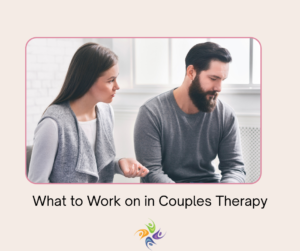
 So you’ve decided to look into couples therapy. Maybe your partner suggested it. Maybe you’ve been quietly Googling on your own. Either way, there’s one thought that keeps coming up: What would we even work on?
It’s a fair question—and one we hear a lot from couples across the Sacramento area who are considering couples therapy and marriage counseling for the first time. If you’re curious about what actually happens in couples therapy, here’s the truth: you don’t have to walk in with a perfect list of problems. A skilled therapist helps you figure out what to focus on—and often, the real issues aren’t what you’d expect. (If you want the “behind the closed door” version, see What Actually Happens in Couples Therapy?)
What Is the Main Goal of Couples Therapy?
The goal of couples therapy isn’t to “fix” one partner or decide who’s right. It’s to help you understand the patterns in your relationship—how you connect, how you fight, and where you get stuck—and give you practical tools to shift those patterns. You work on the relationship itself, not each other.
Most couples walk into therapy secretly hoping the therapist will tap the other person on the shoulder and say, “So here’s what you need to change.”
I get it. When you’re hurting, you want relief. But Gottman-based couples therapy starts with a different (and more useful) reframe:
The relationship is the client.
That means both partners contribute to the dynamic, and both partners have a role in changing it. Not in a blame-y “it’s 50/50” way—but in a systems way. When one person shifts their part of the pattern, the whole pattern changes.
It’s about patterns, not just problems
Most couples think their issue is the content: money, chores, the in-laws, parenting, or intimacy. Those topics matter. But the real work is usually the cycle underneath:
- how you bring things up
- how you respond
- how quickly things escalate
- whether you repair or shut down
- whether you feel like teammates or adversaries
A Gottman-trained therapist is watching the pattern, not just the headline topic.
Practical tools are the endgame
This isn’t open-ended “how does that make you feel?” therapy with no direction. At The Relationship Therapy Center, the goal is to send you home with tools you can use that same week. Nancy’s team uses 50+ research-based interventions, matched to what your relationship actually needs—based on the Gottman Assessment.
You’re building something, not just processing
Think of couples therapy like learning a language. You’re learning the language of your relationship—how to speak it, how to hear it, and how to repair when things go sideways.
How Do I Bring Up Something That Is Hard With My Spouse Without Starting a Fight?
One of the first Gottman skills couples learn is the “softened startup”—raising a concern without triggering defensiveness. Research shows the first three minutes of a conversation predict how it will end. Starting softer doesn’t mean sugarcoating. It means leading with your feelings and needs instead of blame and criticism.
If you’ve ever had a conversation go from “Can we talk?” to “Why are you yelling?” in under 90 seconds, you’ve already met the power of a bad start.
Gottman’s research found that conversations almost always end on the same note they begin. So if you start with criticism, you usually end in a fight. If you start with a feeling and a need, the conversation has room to go somewhere productive.
What a softened startup looks like vs. a harsh one
Harsh: “You never listen to me. You’re always on your phone.”
Softened: “I miss talking to you at dinner. Can we try putting our phones away tonight?”
Notice the difference isn’t just being “nicer.” It’s being clearer about what you actually need.
This is something you practice in session
At RTC, your therapist helps you identify your pattern (for example: one criticizes → the other gets defensive → both shut down) and then coaches you through doing it differently, in real time.
That’s the value of working with a therapist trained in the full Gottman toolkit—not just theory, but hands-on practice with real moments.
It works for small stuff too
Softened startup isn’t only for heavy conversations. It changes how you talk about:
- whose turn it is to pick up the kids
- why the credit card bill was higher than expected
- where you’re spending Thanksgiving
- how often you actually want to see friends versus rest
When the “small stuff” stops turning into war, the relationship gets lighter—fast.
What Do I Say When My Partner Shuts Down?
When your partner goes quiet mid-conversation, they may be flooded—emotionally overwhelmed to the point they can’t process the discussion. It’s not apathy; it’s a nervous system shutdown. Pushing harder makes it worse. Gottman therapy teaches structured breaks (at least 20 minutes) and repair attempts that help you return safely.
If your partner shuts down—arms crossed, eyes glazed, one-word answers—it can feel like rejection. The instinct is to pursue harder: follow them, raise your voice, demand engagement.
But what’s often happening is flooding.
Flooding in plain language
Flooding is when your nervous system becomes so overwhelmed that it goes into fight-or-flight. Stress hormones spike. Your heart rate rises. Your capacity to listen, empathize, and problem-solve drops dramatically.
Some people look “big” when flooded (louder, more intense). Others look “gone” (quiet, blank, silent). Both are flooded—they just wear it differently.
Why “Just talk to me!” doesn’t work
When someone is flooded, they physically can’t engage productively. Pushing them to talk is like asking someone to run on a broken ankle. You can ask harder, but it doesn’t make the ankle work.
What to do instead: the structured break
In Gottman Method therapy, couples learn to take breaks the right way:
- agree to pause for at least 20 minutes (minimum time for the nervous system to calm)
- do something soothing and distracting (walk, shower, music—not rehearsing arguments)
- and come back to the conversation
The coming-back part is critical. Without it, breaks turn into avoidance and resentment.
Repair attempts after the break
This is where couples therapy really shines. Your therapist helps you learn how to re-enter the conversation with a repair attempt—something that signals, “I’m still here. I still care. Let’s try again.”
Research shows that the success of repair attempts (not just making them) is one of the strongest predictors of relationship health.
And yes—this is a pattern RTC sees constantly: one partner pursues, the other withdraws. It’s one of the most common couples’ dynamics, and specific Gottman interventions are designed to address it.
What Is the Key to a Successful Marriage?
Decades of Gottman research suggest the key isn’t avoiding conflict—it’s maintaining a strong friendship underneath it. Couples who “turn toward” each other in everyday moments build a foundation that can weather stress. Therapy strengthens Love Maps, appreciation, rituals of connection, and the 5:1 ratio of positive to negative interactions.
This surprises many couples: they come in wanting to fix the fighting—and yes, we do that. But Gottman’s research is clear: the couples who thrive long-term are the ones who nurture their friendship system.
Friendship is the foundation
Friendship includes:
- knowing your partner’s inner world (Love Maps)
- expressing appreciation (fondness and admiration)
- responding to bids for connection (turning toward)
Turning toward in everyday moments
When your partner says, “Look at that sunset,” and you look up from your phone—that’s a bid for connection that just got accepted.
Those tiny moments add up. Research suggests couples who stay together turn toward bids about 86% of the time, while couples who divorce do so around 33% of the time.
The 5:1 ratio
Another major Gottman finding: in healthy relationships, there are about five positive interactions for every one negative, even during disagreements. Couples therapy helps rebuild that positive foundation, so you have something to draw from when life gets hard.
This is what you actually work on (not just a nice idea)
At RTC, friendship-building becomes part of the treatment plan. Couples practice:
- Love Maps exercises
- rituals of connection (morning goodbye, daily check-in, weekly date)
- ways to express fondness and admiration consistently
These are specific, doable skills—not vague advice to “be nicer.”
And it’s especially relevant for Sacramento-area couples who tell us they feel like roommates—managing logistics and kid schedules without ever actually connecting. The friendship work changes that.
Start Couples Therapy in Roseville or Fair Oaks
If you’re wondering what you’d even talk about in couples therapy, you probably already know—the pattern that repeats, the conversation you avoid, the thing that keeps you up at night. You don’t need a perfect list. RTC starts with a comprehensive assessment to build a clear plan around your relationship, with offices in Roseville and Fair Oaks and telehealth across California.
With offices in Roseville (near Highway 65 and Highway 80) and Fair Oaks (near Highway 50 and Sunrise Blvd.), and telehealth available throughout California, getting started is simple:
- Reach out — Call, text, or fill out our online form
- Get matched — We’ll connect you with the right therapist for your situation
- Start working on what matters — With a clear plan and real tools
Certified Gottman Therapist
Nancy Ryan, LMFT & Certified Gottman Therapist, is the Founder and Clinical Director of Relationship Therapy Center, with 15+ years of experience supporting clients in Sacramento, Placer, and El Dorado Counties, and with offices in Roseville, CA, and Fair Oaks, CA. Our team also supports clients throughout California, Idaho, and Washington
She specializes in couples counseling, mentoring, and training her therapists on how to be excellent therapists. Nancy is also featured in a variety of media and provides couples therapy weekend workshops and retreats.
Relationship Therapy Center uses evidence-based approaches such as EMDR for trauma, Cognitive Behavioral Therapy (CBT), Acceptance and Commitment Therapy (ACT), Dialectical Behavior Therapy (DBT), Mindfulness, and Motivational Interviewing to treat individuals. Family therapy focuses on family systems and Play Therapy for children. Evidence-based couples therapy includes using the Gottman Method, Gottman Method Affair recovery/infidelity counseling, Emotionally Focused Therapy (EFT), Attachment therapy, and David Schnarch's Crucible Therapy, including differentiation. The whole team is in weekly training on trauma-informed care, somatic techniques, sex therapy, and different topics each year.
- Therapist for Childhood Emotional Neglect - October 8, 2026
- How do I Know if I Have Postpartum Depression? - October 1, 2026
- Is It a Midlife Crisis? - September 24, 2026