
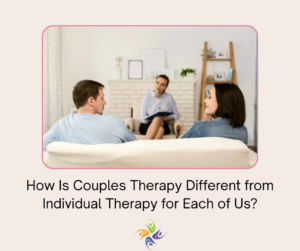
 “I already have my own therapist—do we really need couples therapy too?” It’s a question that comes up a lot, especially among couples in the greater Sacramento area where investing in personal growth through individual therapy is already part of the routine. The short answer: individual therapy and couples therapy do very different things. Your individual therapist is focused on you. In couples therapy and marriage counseling, the relationship itself is the focus—the patterns between you, not just within you. If you’ve been wondering what actually happens in couples therapy and how it’s different from what you’re already doing, here’s what to know.
What Is the Difference Between Couples Therapy and Individual Therapy?
Individual therapy focuses on your inner world—your thoughts, feelings, history, and coping strategies. Couples therapy focuses on the dynamic between you and your partner: how you communicate, handle conflict, repair, and reconnect. In couples work, the relationship itself becomes the client, and the goal is to change the pattern—not just understand it.
Think of individual therapy as working “inside the house.” Couples therapy is working on the “wiring between two houses.”
Different goals
Individual therapy helps you understand yourself better—your triggers, attachment patterns, emotions, boundaries, and coping strategies. That work is valuable and often life-changing.
Couples therapy helps you understand the system you and your partner have created together: the cycle you keep falling into, what sets it off, what keeps it going, and how to change it.
Both are important, but they operate on different levels:
- Individual therapy: insight + healing inside you
- Couples therapy: skills + change between you
Different room dynamics
In individual therapy, your therapist hears one perspective—yours. That’s not a flaw; it’s the purpose. It’s your private space.
In couples therapy, the therapist hears both perspectives and—more importantly—watches the interaction. That real-time view is powerful because your therapist can see patterns neither of you can easily spot from the inside, like:
- the moment one of you shuts down
- how criticism triggers defensiveness
- how a bid for connection gets missed
- how conflict escalates before either of you even realizes it’s happening
This is why couples often say, “We didn’t even notice we do that.” A trained couples therapist does.
The Gottman Method difference (and why it isn’t “individual therapy x2”)
At The Relationship Therapy Center, couples therapy isn’t “two people taking turns talking while the therapist nods.” It’s structured and skill-based.
About 90% of couples complete the Gottman Clinical Assessment, which gives your therapist a research-backed roadmap (friendship, conflict, shared meaning). Then your therapist uses specific interventions designed for relational dynamics—tools like:
- softened / gentle startup
- repair attempts
- managing flooding
- Dreams Within Conflict (for gridlocked, repeating issues)
You can learn and practice communication skills in individual therapy, but you can’t fully change a couple pattern without both people in the room and a therapist trained to work with the interaction.
Why individual therapy alone often can’t fix relationship problems
You can gain incredible self-awareness and still struggle at home—because understanding your own patterns doesn’t automatically change the dynamic between you and your partner, although it can help some.
It takes both of you, together, practicing new ways of responding—especially in the moments that used to spiral. That’s what couples therapy uniquely provides.
If you want the bigger picture of the process, this post pairs well with “What Actually Happens in Couples Therapy?”
Should You Use the Same Therapist for Individual and Couples Therapy?
Generally, no. Your individual therapist needs to be fully “your person,” while your couples therapist must be neutral and hold space for both partners equally. Using the same therapist for both can create an unfair advantage—or at least the feeling of one—undermining trust in the couples work. Separate roles protect the process.
This is one of those questions where the answer matters more than people realize.
Why separate therapists protects the work
Your individual therapist knows your deepest fears, frustrations, triggers, and vulnerabilities. That’s their job. But if that same therapist then becomes the couples therapist, your partner may feel the deck is stacked—even if the therapist tries to stay neutral.
And honestly? It’s very hard for a therapist to “unknow” what they know about one partner and remain truly balanced. Even subtle bias (or perceived bias) can derail couples therapy fast.
The exception: same practice, different therapists
This is one of the strengths of working with a group practice like The Relationship Therapy Center. You can have:
- a couples therapist for the relationship
- separate individual therapists for each of you (if needed)
All under one roof, with the ability to coordinate care with your permission. That means you’re not stuck playing telephone between two separate offices.
RTC’s approach
RTC offers both couples work and individual therapy—including EMDR and Brainspotting for trauma—so couples can access coordinated support when anxiety, trauma, or emotional regulation issues are showing up in the relationship.
What this looks like practically:
- You see a couples therapist together weekly (or in an intensive format)
- You each have your own individual space to process personal work
- The couples therapist stays neutral and focused on the relationship
That structure protects the couples work and respects the individual work.
What Is the Downside of Couples Therapy?
Couples therapy can be uncomfortable. You may hear hard truths, be asked to look at your role in the dynamic, and feel emotionally tired afterward. Progress isn’t always linear, and therapy doesn’t always end in staying together. The “downside” is the cost of real change—but staying stuck for years is usually the bigger cost.
People search this question because they want the truth, not a sales pitch. So here it is: couples therapy is an investment, and it can stretch you.
It requires vulnerability
You’re talking about your most private struggles with someone you just met. That takes courage. Early sessions can feel tender—especially if you’ve been avoiding certain conversations for a long time.
Sometimes it feels worse before it feels better—not because therapy is failing, but because you’re finally telling the truth out loud.
It takes time, money, and commitment
For busy Sacramento-area professionals balancing careers, kids, and life, carving out time is real. Therapy often includes practice between sessions. Weekend intensives are an option for couples who truly can’t do weekly scheduling—but either way, it’s not passive.
It doesn’t always mean staying together
This part matters: sometimes couples discover through therapy that they want different things. At RTC, “success” doesn’t always mean saving the marriage. Sometimes it means making a clear, respectful decision instead of a reactive, painful one.
The reframe
Many of these “downsides” are signs the work is actually happening:
- discomfort means you’re getting beneath the surface
- hearing hard truths means you’re being honest
- feeling exhausted after a session means you did real work
The real downside would be staying stuck in the same patterns for another five years.
What minimizes the downsides
A skilled therapist with a clear plan. This is where quality matters. A structured, research-based approach (like the Gottman Method) gives sessions direction and purpose—you’re not just sitting in discomfort without a path forward.
What Is the Difference Between Couples Therapy and Family Therapy?
Couples therapy focuses on the romantic relationship—communication, conflict, emotional connection, intimacy, and shared goals between two partners. Family therapy is broader and involves multiple family members to address patterns affecting the whole family system. Both are relational, but they differ in scope: couples work centers on the partnership; family work centers on the family unit.
Couples therapy and family therapy both work with relationships—but they’re not interchangeable.
Couples therapy: the relationship is the client
The work centers on the two partners: their patterns, friendship, conflict, trust, intimacy, and the way they navigate life together.
Even when the topic is parenting, the focus stays on how the couple handles parenting conversations—because the couple relationship is usually the foundation of the family system.
Family therapy: the family system is the client
Family therapy may involve parents and children, teens, blended families, or multi-generational dynamics. The therapist looks at the whole system: roles, alliances, boundaries, communication patterns, and how everyone affects everyone else.
When couples issues affect the kids
Sometimes couples therapy is the best thing you can do for your family. When parents are constantly in conflict, emotionally disconnected, or struggling to co-parent, strengthening the couple often stabilizes the whole household—whether or not kids are in the room.
How RTC approaches it
At The Relationship Therapy Center, we work with couples at every stage—including parenting challenges, blended family dynamics, and major transitions like the empty nest. If family therapy is needed alongside or instead of couples work, that’s something your therapist can help you determine during the assessment process.
The overlap is this: both are about patterns. The Gottman Method is specifically designed for the couple dynamic, which is why it’s so effective for that particular relationship.
Begin Couples Therapy or Marriage Counseling in Fair Oaks or Roseville
Your individual therapy is for you. Couples therapy is for what happens between you. When both work together, results can be powerful. RTC offers couples therapy and individual counseling under one roof—including EMDR and Brainspotting—so support can be coordinated without juggling multiple practices across the Sacramento area. Your therapy starts with assessment, a clear plan, and usable tools.
Every couple’s therapist on our team is personally trained and supervised by the only Certified Gottman Method Therapist in Sacramento. Your therapy starts with a comprehensive assessment, a clear plan, and tools you’ll actually use.
Ready to take the next step?
- Get in touch — Call, text, or complete our contact form
- Get matched with the right therapist — For your relationship and for you individually, if needed
- Start building a stronger foundation — With a team that sees the whole picture
Certified Gottman Therapist
Nancy Ryan, LMFT & Certified Gottman Therapist, is the Founder and Clinical Director of Relationship Therapy Center, with 15+ years of experience supporting clients in Sacramento, Placer, and El Dorado Counties, and with offices in Roseville, CA, and Fair Oaks, CA. Our team also supports clients throughout California, Idaho, and Washington
She specializes in couples counseling, mentoring, and training her therapists on how to be excellent therapists. Nancy is also featured in a variety of media and provides couples therapy weekend workshops and retreats.
Relationship Therapy Center uses evidence-based approaches such as EMDR for trauma, Cognitive Behavioral Therapy (CBT), Acceptance and Commitment Therapy (ACT), Dialectical Behavior Therapy (DBT), Mindfulness, and Motivational Interviewing to treat individuals. Family therapy focuses on family systems and Play Therapy for children. Evidence-based couples therapy includes using the Gottman Method, Gottman Method Affair recovery/infidelity counseling, Emotionally Focused Therapy (EFT), Attachment therapy, and David Schnarch's Crucible Therapy, including differentiation. The whole team is in weekly training on trauma-informed care, somatic techniques, sex therapy, and different topics each year.
- How Is Couples Therapy Different from Individual Therapy for Each of Us? - March 24, 2026
- Why Do Children Need Behavioral Therapy? - March 19, 2026
- What Actually Happens in Couples Therapy? - March 17, 2026