
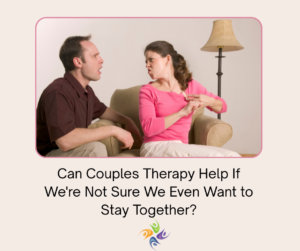
 If you’re not sure whether you want to stay in your marriage, couples therapy can still help—maybe even especially then.
Here’s something that might surprise you: a “successful” outcome in couples therapy doesn’t always mean staying together. Sometimes it means finally getting the clarity you need to make a decision—one way or the other—with support instead of reactivity.
At The Relationship Therapy Center in Roseville and Fair Oaks, we regularly work with couples across the Sacramento area who are unsure about their future. Couples therapy and marriage counseling aren’t just for couples who’ve already decided to stay. It’s for couples who need help figuring out what’s next.
Is It Better to Divorce or Stay Unhappily Married?
This is one of the hardest questions anyone faces, and there’s no universal right answer. Both staying and leaving come with real costs and real possibilities. Couples therapy offers a structured space to explore the question honestly, separate temporary emotions from deeper patterns, and make a thoughtful decision you can live with—without pressure or judgment.
If you’re staring at this question, you’re probably holding multiple truths at once: love and resentment, hope and exhaustion, guilt and relief. That’s why this question is so hard—because it’s not just a decision about a relationship. It can feel like a decision about your identity, your family, your future, and what you “should” be able to tolerate.
Why is this question so hard
- There’s no universal “right” answer
- Both options have real costs and real possibilities
- Fear, guilt, hope, and exhaustion cloud the decision
- You may be getting conflicting advice—from friends, family, or your own internal voices
One part of you may be saying, “Try harder.” Another part may be whispering, “I can’t do this anymore.” Both voices deserve to be heard—without either one running the whole show.
What couples therapy offers
Couples therapy can create a structured place to explore the question honestly:
- separating temporary feelings from deeper patterns
- clarifying what’s fixable vs. what may be a fundamental incompatibility
- supporting BOTH partners, regardless of the outcome
And here’s the reframe we come back to often:
A “successful” outcome doesn’t always mean staying together. Sometimes it means making a thoughtful, supported decision rather than a reactive one.
Therapy helps you make a decision you can live with—not one made in the heat of anger, desperation, or sheer depletion.
What happens without support
When couples don’t have a structured place to sort this out:
- Decisions made reactively (during a fight, after a final straw) often lead to regret
- Staying without addressing the issues leads to more years of unhappiness
- Leaving without clarity can mean repeating patterns in the next relationship
If you’re stuck in limbo, therapy can help you move forward—either toward rebuilding or toward letting go with intention and respect.
How Do You Know When a Marriage Is Over?
There isn’t one single sign a marriage is “over,” but there are patterns that suggest you’ve reached a crossroads: emotional shutdown, chronic disengagement, or one partner already halfway gone. At the same time, many signs that feel scary—distance, repeated fights, rough patches—can be workable. Therapy can clarify what’s happening and what’s possible.
People often look for a clear line in the sand—“If this happens, it means the marriage is over.” Unfortunately (and also fortunately), relationships don’t work like that.
There’s no single universal sign. But there are patterns that suggest you may be at a crossroads—and that professional support could help you see clearly.
Signs you may be at a crossroads
- One or both partners have emotionally checked out
- You’re fantasizing about life without your partner—not occasionally, but regularly
- “I love you, but I’m not in love with you” (this one needs to be unpacked)
- You’ve stopped fighting—not because things are better, but because you’ve given up
- One partner has a foot out the door
- You’re staying “for the kids” or “because it’s easier,” but feel dead inside
Signs that don’t necessarily mean it’s over
These may feel alarming, but they’re often workable—especially with the right tools:
- Feeling disconnected or distant
- Having the same fight repeatedly (Gottman research shows 69% of conflicts are perpetual—it’s about how you handle them)
- Going through a rough patch during a major life transition
- Feeling attracted to someone else (often a symptom of disconnection, not a death sentence)
The honest truth
A therapist can’t tell you whether your marriage is “over.” But a skilled couples therapist can help you understand what’s actually happening, how entrenched the patterns are, and teach you new skills if both of you want to work on it. Then you have more data.
Sometimes couples discover they do want to fight for it—once they have tools and structure, not chaos. Sometimes they realize they’ve been holding on to something that ended a long time ago.
Either way, clarity is a form of relief.
If you are curious about what common problems bring other couples to therapy you might want to read this blog.
Can Marriage Counseling Really Save a Marriage?
Yes—marriage counseling can help many couples rebuild satisfaction, trust, and connection, especially when both partners are willing to engage. But “saving” a marriage isn’t always the goal, and it isn’t something a therapist does to you. Therapy provides structure and tools; you use them to rebuild—or to separate thoughtfully if that becomes the healthiest path.
Couples therapy can absolutely help many couples recover—especially when the work is structured, skill-based, and grounded in research.
What the research shows
The Gottman Method has a strong evidence base for improving relationship satisfaction. Couples who learn and practice specific skills—repair attempts, accepting influence, managing flooding—often see significant improvement.
And yes, couples who come in earlier tend to have an easier road. But it’s also rarely “too late” if both partners are willing.
What “saving” a marriage actually means
When people say “save,” they usually mean:
- learning to handle conflict without destroying each other
- rebuilding friendship, trust, and emotional connection
- creating shared meaning and goals for the future
- feeling like partners again instead of adversaries
In other words, it’s not returning to who you were at the beginning. It’s building a new version of the relationship that fits who you are now.
When the outcome is separation
Sometimes couples therapy helps partners realize—with support and clarity—that separating is the right choice. When that happens, they can do so respectfully, without the reactivity and pain that comes from making that decision alone.
Couples who separate after therapy often:
- co-parent better
- communicate more effectively
- avoid a scorched-earth conflict that damages everyone involved
That is still a successful outcome—just not the one people expect.
What therapy can’t do
- Force someone to stay who’s already decided to leave
- Fix a relationship where only one person is willing to work
- Make the decision for you
Therapy can guide, clarify, and teach skills. It can’t replace willingness.
What If Only One of Us Wants to Save the Marriage?
Mixed motivation is incredibly common—one partner is often more ready than the other. The hesitant partner may be protecting themselves from more disappointment or carrying deeper hurt. Therapy can still help by creating space for honest exploration, reducing reactivity, and clarifying what each person is willing to do. Even painful clarity is better than staying stuck.
If you’re the partner who wants to fight for the relationship, it can feel devastating when your spouse seems unsure. And if you’re the unsure one, it can feel suffocating to be pushed toward a decision before you have clarity.
Here’s the reality: equal motivation at the same time is rare.
The reality of mixed motivation
- One partner is usually more ready
- The hesitant partner may be protecting themselves from more disappointment
- Sometimes the reluctant partner is the one who’s been hurt the most
What therapy can offer
Therapy can provide:
- space for the ambivalent partner to explore feelings honestly
- a chance for the committed partner to understand what’s really going on
- clarity—even if that clarity is painful
Options when motivation differs
Often, once couples are in the room with a skilled therapist, the hesitant partner opens up—especially when therapy feels structured and neutral.
RTC also works with individuals navigating relationship decisions (sometimes called “relationship therapy for one”). And for couples who need clarity more quickly, weekend intensives can offer focused, immersive work.
The outcome either way
If you both decide to work on it, you leave with a real plan and real tools.
If you decide to separate, you do so with less reactivity and more respect.
Either outcome is better than staying stuck in limbo.
Begin Couples Therapy in the Sacramento Area
If you’re unsure whether your marriage is worth saving—or even what “saving it” would mean—you don’t have to figure it out alone. Couples therapy can help you find clarity, whether that leads to rebuilding your relationship or separating with intention and respect.
At The Relationship Therapy Center, we work with “on the brink” couples regularly. We won’t push you toward a predetermined outcome. We’ll help you understand what’s actually happening in your relationship, explore whether both of you want to work on it, and support whatever decision you make.
Our Gottman-trained therapists serve couples throughout Roseville, Fair Oaks, and the greater Sacramento area. For couples who need clarity faster, our weekend couples intensive offers a focused, immersive experience.
To get started, follow these three steps:
Certified Gottman Therapist
Nancy Ryan, LMFT & Certified Gottman Therapist, is the Founder and Clinical Director of Relationship Therapy Center, with 15+ years of experience supporting clients in Sacramento, Placer, and El Dorado Counties, and with offices in Roseville, CA, and Fair Oaks, CA. Our team also supports clients throughout California, Idaho, and Washington
She specializes in couples counseling, mentoring, and training her therapists on how to be excellent therapists. Nancy is also featured in a variety of media and provides couples therapy weekend workshops and retreats.
Relationship Therapy Center uses evidence-based approaches such as EMDR for trauma, Cognitive Behavioral Therapy (CBT), Acceptance and Commitment Therapy (ACT), Dialectical Behavior Therapy (DBT), Mindfulness, and Motivational Interviewing to treat individuals. Family therapy focuses on family systems and Play Therapy for children. Evidence-based couples therapy includes using the Gottman Method, Gottman Method Affair recovery/infidelity counseling, Emotionally Focused Therapy (EFT), Attachment therapy, and David Schnarch's Crucible Therapy, including differentiation. The whole team is in weekly training on trauma-informed care, somatic techniques, sex therapy, and different topics each year.
- How Do You Release Trauma Stored in Your Body? - March 12, 2026
- Can Couples Therapy Help if We’re Not Sure We Want to Stay Together? - March 5, 2026
- Can a Marriage Counselor Save a Marriage? - February 26, 2026